Understanding Battery Capacity, AH Rating & Backup Time
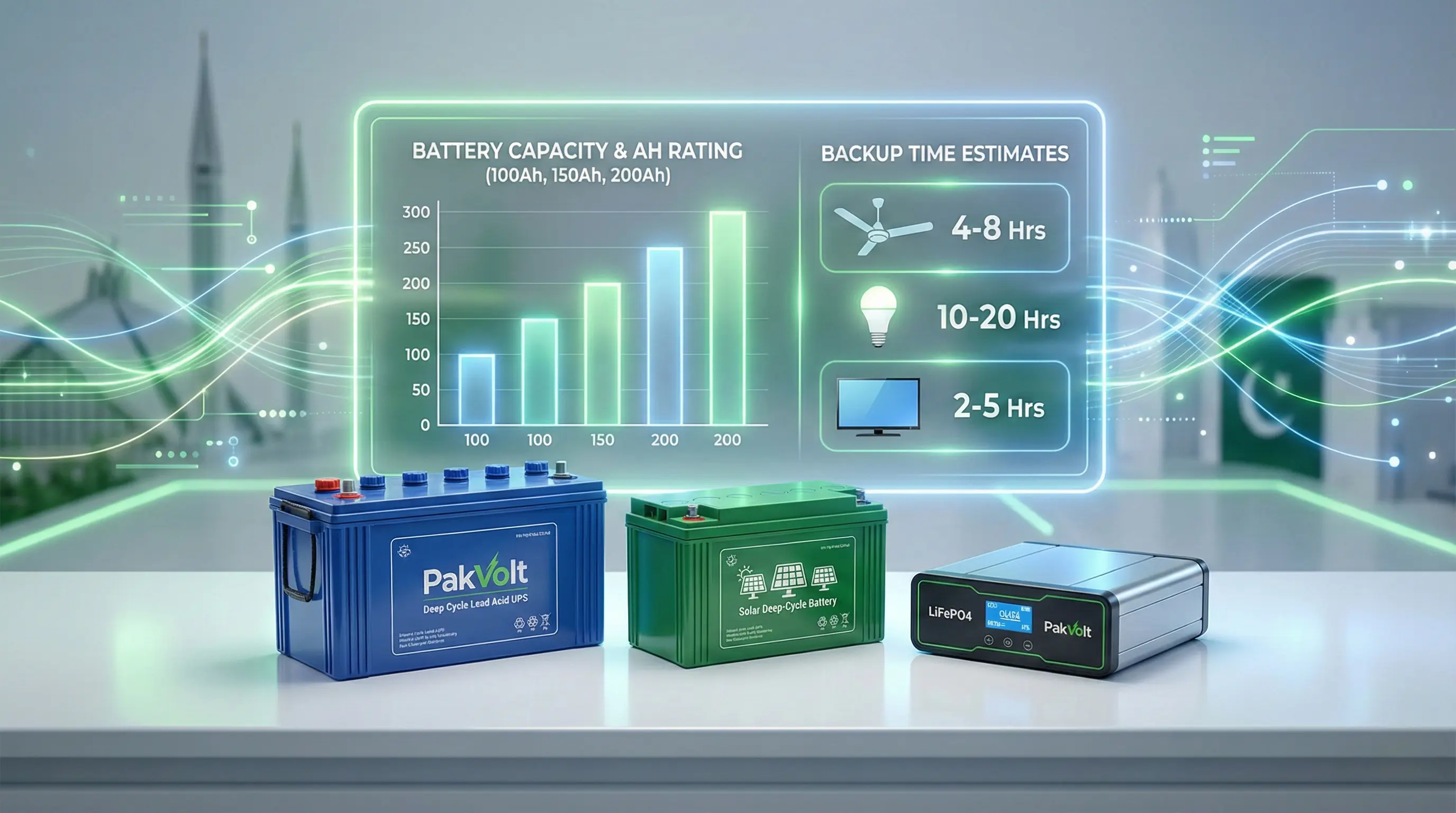
Understanding Battery Capacity, AH Rating & Backup Time
A Complete Guide for Pakistani Homes, Offices & Solar Users
Load-shedding, voltage drops, and fluctuating power supply are everyday problems in Pakistan. Whether you are running a UPS at home, powering a shop, or setting up a solar system, one question matters most:
👉 "How long will my battery last?"
To answer this, you must understand three things:
Battery Capacity
AH (Ampere-Hour) Rating
Backup Time Calculation
Many people buy batteries without understanding these numbers and end up with poor performance, short backup, or a mismatched system. This guide from PakVolt — Pakistan’s trusted hub for large batteries and electric solutions — explains everything in simple, clear language.
🟩 What Is Battery Capacity?
Battery capacity represents how much energy a battery can store. It is usually written in:
Ampere-Hours (AH) for lead-acid batteries
Watt-Hours (Wh) or Kilowatt-Hours (kWh) for lithium or solar batteries
🔋 Simple Definition
Battery capacity = The total amount of electricity the battery can deliver before it needs recharging.
💡 Real-Life Example
A 150AH battery can deliver:
150 amps for 1 hour
or 75 amps for 2 hours
or 15 amps for 10 hours
This does not mean it will always give the same backup because backup depends on load, discharge rate, age, temperature, and battery health.
🟩 What Does AH Rating Mean? (Ampere-Hour Explained)
The AH rating tells you how much current the battery can supply for a specific time.
🔍 Example
A 12V 180AH UPS battery means:
It provides 180 amps for 1 hour
or 18 amps for 10 hours
The AH rating is a critical factor when choosing:
Home UPS batteries
Solar deep-cycle batteries
Tubular batteries
Electric vehicle batteries in Pakistan
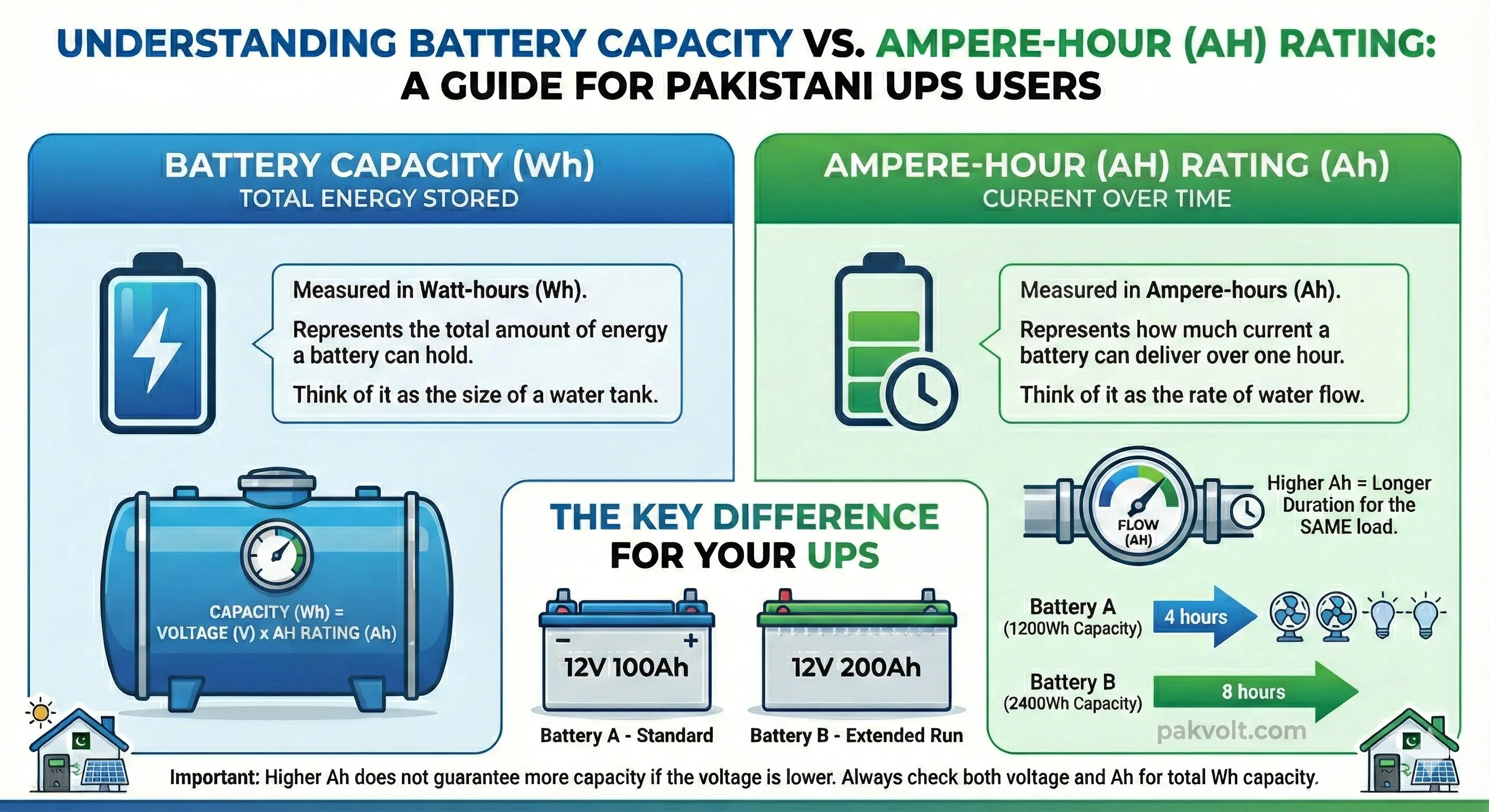
🟩 Voltage vs AH — What’s the Difference?
Many people confuse voltage with capacity.
⚡ Voltage (V)
Represents pressure of electricity (e.g., 12V, 24V, 48V).
🔋 AH (Ampere-Hour)
Represents storage of electricity.
📌 Simple Analogy
Voltage = Water pressure
AH = Water tank size
Both matter, but AH determines backup time.
🟩 Battery Types Common in Pakistan
1️⃣ Lead-Acid Batteries (Most Popular)
Used for UPS, inverters, homes, small shops
Affordable
Easy to maintain
Common capacities: 100AH, 150AH, 180AH, 200AH
2️⃣ Tubular Batteries
Designed for longer backup
Better for deep-cycle use
Ideal for solar systems
3️⃣ Lithium-Ion Batteries
High efficiency
Lightweight
Long life-cycle
Used in modern solar and EV applications
More expensive but best long-term value

🟩 How Battery Capacity & AH Affect Backup Time
Backup time mainly depends on:
Battery Voltage (V)
Battery AH rating
Load (Watts)
Battery efficiency
Depth of discharge (DOD)
🧮 Backup Time Formula (UPS & Solar Systems)
Typical efficiency range for lead-acid = 70% to 80%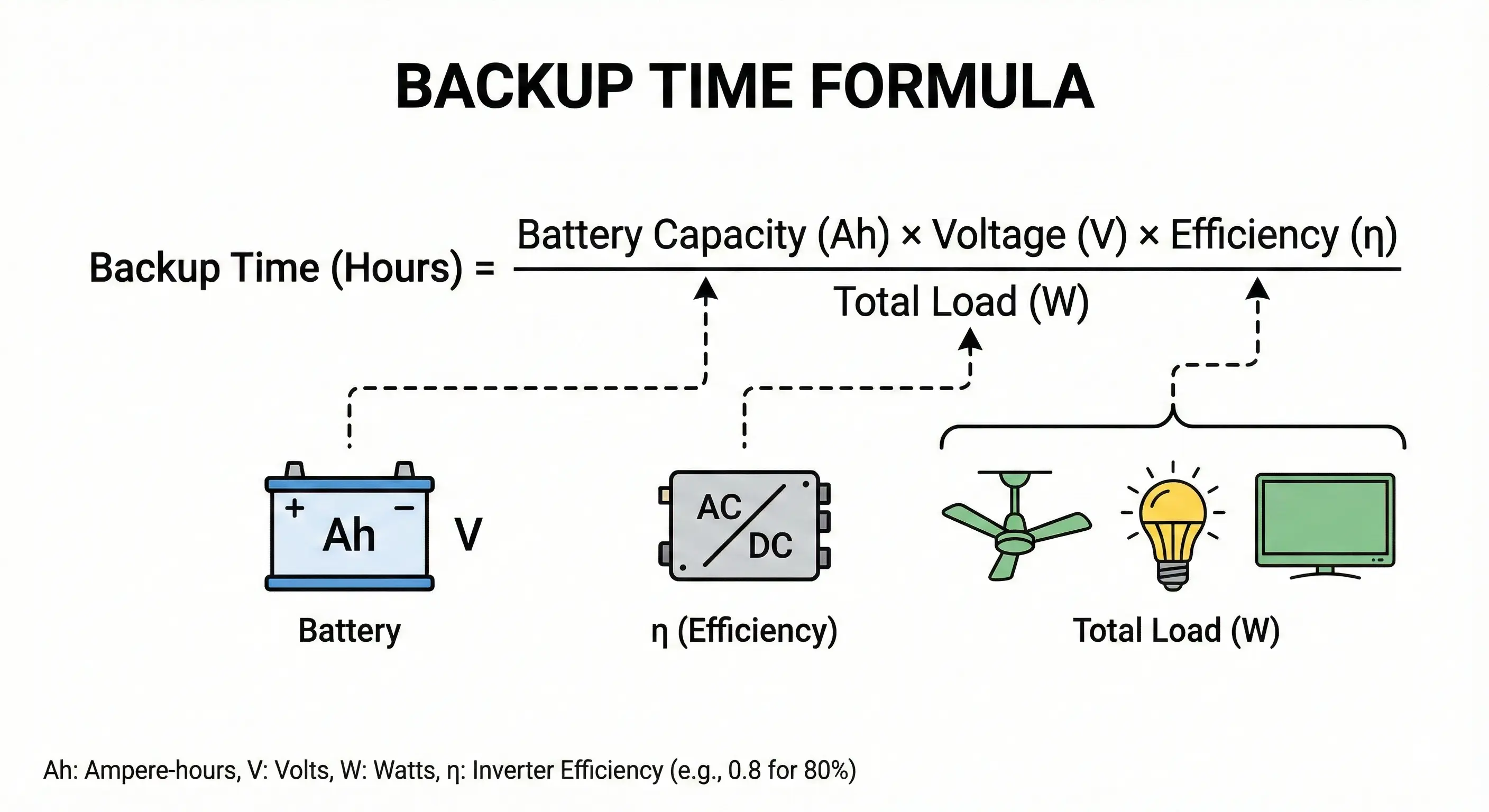
🟩 Backup Time Examples (Real Pakistani Use Cases)
Let’s calculate for a 12V 150AH battery with 80% efficiency.
Example 1 — Home UPS (Fan + Lights)
Load:
1 fan = 70W
3 LED bulbs = 24W
WiFi router = 12W
Total = 106W
Calculation:
👉 Expected backup: 8–13 hours (depending on battery age)
Example 2 — 1500W Solar Inverter Load
Load:
2 fans
6 bulbs
1 TV
Total = 250W
👉 Expected backup: 4.5–6 hours
Example 3 — Office Load
Load:
2 laptops = 110W
1 internet router = 12W
1 fan = 70W
Total = 192W
👉 Expected backup: 6–8 hours
🟩 Why Backup Time Differs from Person to Person
Even with the same battery & load, backup differs due to:
✔ Battery Age
Older batteries store less energy.
✔ Temperature
High Pakistani heat reduces performance.
✔ Voltage fluctuations
Low voltage forces the battery to discharge harder.
✔ Wiring & inverter efficiency
Poor wiring can reduce backup by 10–20%.
✔ Battery health
Sulphation, low water levels, corrosion affect storage.
🟩 How to Choose the Right Battery for Your Needs
Here is a simple, Pakistan-friendly guide:
1️⃣ For Home UPS (Load-shedding)
Choose:
150AH – 200AH lead-acid or tubular battery
Why:Affordable
Good backup for fans/lights
2️⃣ For Solar Systems
Choose:
Tubular batteries (deep cycle)
or Lithium-ion (LiFePO4)
Why:Deep discharge support
Long life
3️⃣ For Shops/Offices
Choose:
150AH–180AH lead-acid battery
Why:Stable
Great for fans, routers, lights, computers
4️⃣ For Heavy Backup Requirements
Choose:
2× 200AH batteries (24V system)
Why:More stable
Higher energy capacity
🟩 Signs Your Battery Is Losing Capacity
Watch for:
Backup getting shorter
Battery heating
Unusual smell
Acid leakage
Need for frequent charging
Voltage drop
High water consumption
If you see these signs, battery replacement may be needed.
🟩 Tips to Increase Backup Time & Battery Life
These are proven tips for Pakistani weather conditions:
🔧 1. Maintain proper water levels
Only use distilled water, never tap water.
🔋 2. Avoid over-discharging
Do not drain battery below 50% on a daily basis.
☀️ 3. Keep battery in a cool, ventilated area
Heat reduces life by up to 40%.
⚡ 4. Use energy-efficient appliances (LED fans, DC fans)
Less load = more backup.
🔌 5. Ensure tight connections and corrosion-free terminals
Poor terminals reduce efficiency.
☑ 6. Charge battery fully before first use
Ensures longer lifespan.
🟩 Common FAQs (Pakistan-Specific)
Q1: What is the ideal battery size for a 1.2-ton inverter AC?
ACs require high power, so batteries alone are not recommended. Use solar with lithium storage.
Q2: Can a 150AH battery run a fridge?
Yes, but backup will be low (1–2 hours). Solar is recommended.
Q3: Is 200AH battery better than 150AH?
Yes — higher AH means more storage and longer backup.
Q4: How long does a lead-acid battery last in Pakistan?
Typically 2–3 years, depending on usage & weather.
Q5: Which battery gives the longest backup?
Lithium (LiFePO4) batteries provide the best long-term backup.
🟩 Conclusion & Call-to-Action
Understanding battery capacity, AH rating, and backup time helps you make the right decision for your home, solar system, or business. Whether you need long backup, deep-cycle stability, or high-efficiency lithium solutions, PakVolt has the expertise and products to guide you.
👉 Need help choosing the right battery? Contact PakVolt for expert advice and the best prices in Pakistan.
👉 Visit PakVolt today and power your home the smart way!
About Me

Latest Posts
Related Articles

Best UPS Battery for Gaming PCs in Pakistan: High Power Solutions
Discover the best UPS batteries for gaming PCs in Pakistan, including Phoenix TX-1800, Osaka TA-1600, and...
How to Choose the Best UPS Battery for Home and Office Use in Pakistan: A Complete Guide
Learn how to choose the best UPS battery for home and office use in Pakistan. Explore...